
Case Study
Warrington and Halton Hospitals NHS Foundation Trust
Hardware Refresh
Executive Summary
This is the account of how max20 Project Solutions successfully delivered a complex hardware refresh programme for Warrington and Halton Hospitals NHS Foundation Trust (WHH), replacing critical end-user computing equipment across the organisation whilst ensuring minimal impact to Clinical users and other Digital teams. The project encompassed improved performance, reliability, and supportability of IT infrastructure.
Key Highlights:
- Delivered a full-scale hardware refresh across multiple sites
- Successfully upgraded over 2,600 devices within planned timelines
- Ensured minimal disruption to clinical services during deployment
- Implemented standardised builds using SCCM for consistency and efficiency
- Managed end-to-end lifecycle, including decommissioning and disposal
- Updated and maintained accurate asset register records
- Supported deployment of bespoke and clinical applications
- Delivered new cabling and infrastructure improvements where required
In numbers:
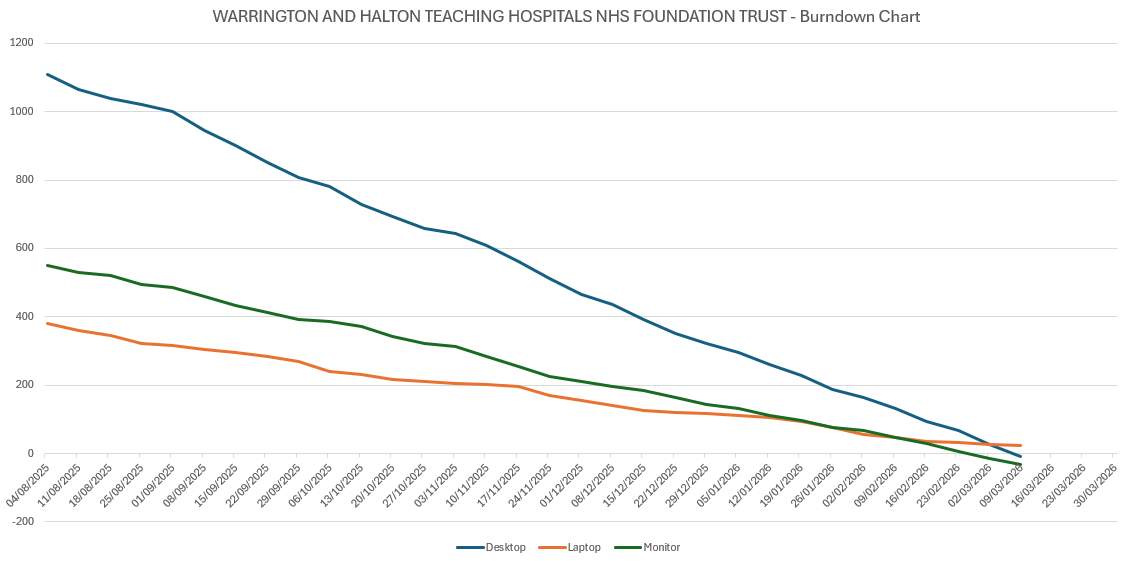
- 1,100 desktops replaced
- 500 laptops deployed
- 500 monitors installed
- 500 peripherals (keyboards, mice, specialist devices) deployed
- 2,600+ total assets refreshed
- Multiple sites covered across WHH NHS Trust
- End-to-end delivery from build to decommission

The Challenges
Delivering a project of this scale within a healthcare environment required careful planning and coordination to address a number of complex challenges. A key consideration was the operational sensitivity of the NHS setting, where maintaining continuity of clinical services was critical. Any disruption to systems or end-user devices had the potential to impact patient care, so deployments needed to be tightly controlled and often scheduled around clinical priorities.
The Trust’s estate added further complexity, with multiple locations featuring varying infrastructure standards and technical requirements. This variability required flexible deployment approaches and additional on-site adjustments, particularly where new cabling or infrastructure upgrades were necessary.
Legacy systems also presented challenges, particularly in ensuring compatibility with newer hardware and operating environments. Several departments relied on bespoke or specialist clinical applications, requiring additional testing and validation to ensure seamless functionality post-deployment.
Accurate asset management was another significant factor. Existing asset registers did not always fully reflect the current estate, meaning reconciliation activities were required to ensure accurate tracking of both new and decommissioned equipment.
Logistical coordination across sites was demanding, involving the movement, installation, and removal of large volumes of equipment within tight timeframes. This was further compounded by the need to maintain strict data security and compliance standards, particularly during the decommissioning and disposal of legacy hardware.
Overall, the combination of operational sensitivity, technical complexity, logistical scale, and compliance requirements required a highly structured and adaptable delivery approach.
The Solution
Approach
- Conducted comprehensive hardware audit to identify assets for replacement
- Standardised device builds via SCCM
- Established pre-build and staging processes to streamline deployment
- Coordinated phased rollout plans aligned with operational priorities
- Delivered on-site installation, including cabling and setup
- Installed and validated bespoke and clinical software requirements
- Maintained and updated central asset register in real time
- Managed secure decommissioning and disposal of legacy hardware
- Provided on-site technical support during deployment phases
max20 Project Solutions adopted a structured and phased delivery model to ensure efficiency and minimal disruption. The project began with a detailed audit of existing hardware, enabling accurate identification of devices requiring replacement.
Standardised builds were rigorously tested using SCCM, ensuring consistency across all deployed devices. Pre-staging of hardware allowed rapid deployment, reducing on-site configuration time.
Rollouts were carefully scheduled in collaboration with WHH NHS Trust stakeholders, prioritising critical departments and aligning with operational windows. Where necessary, new cabling was installed to support upgraded equipment and improve infrastructure reliability.
Special attention was given to bespoke and clinical applications, ensuring compatibility and continuity of service. Throughout the deployment, the asset register was continuously updated to reflect new installations and removed devices.
Legacy hardware was securely decommissioned in line with NHS data security and environmental standards, completing the full lifecycle management of the refresh.
The Outcomes
The hardware refresh programme delivered significant operational and technical benefits to WHH NHS Trust. The organisation now benefits from a modern, standardised IT estate that enhances performance, reliability, and user experience. The improved infrastructure supports clinical and administrative staff in delivering efficient patient care, with faster systems and reduced downtime. The use of SCCM-based builds ensures easier ongoing management and scalability, while accurate asset tracking improves governance and compliance. The structured decommissioning process also ensured secure data handling and environmentally responsible disposal. Overall, the project was delivered on time, within scope, and with minimal disruption—demonstrating max20 Project Solutions’ capability to execute complex, large-scale IT transformations within sensitive healthcare environments.